


















Talking silently

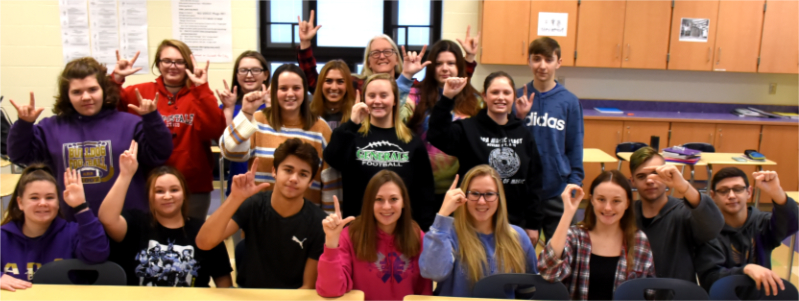
Students are not only learning a new language, but learn about a culture that exists in thousands of communities across the U.S. It’s not just an academic lesson, but a life lesson.
By Barbara Lockard
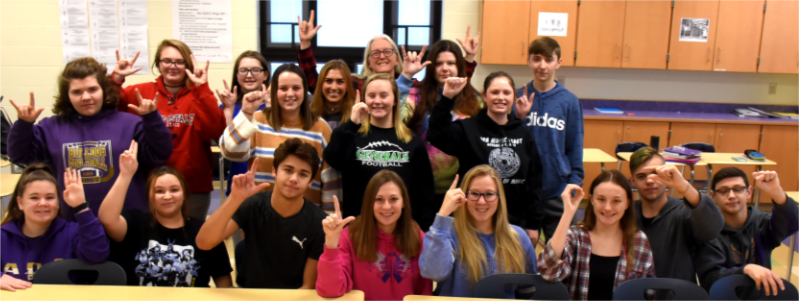
Fifty Ada High School students have been learning a language that requires hand gestures, facial expressions and whole-body engagement.
American Sign Language (ASL) is being offered as a foreign language credit and has really caught on with the students. As the third most spoken language in the U.S., ASL is becoming increasingly popular as a foreign language option in high schools and colleges across the country.
So far, Ada students think it’s a lot of fun.
“We have a very active class,” said Elaine Garber, ASL instructor. For example, they recently played telephone with hilarious results. “It showed us that you can have problems communicating in sign language as well as with the spoken word,” she laughed.
Garber joined the Ada High School faculty in 2019. A resident of Elida, she had taught ASL, deaf education and special education for the past 11 years, including five years at Jean Massieu Academy for the Deaf in Arlington, Texas.
She holds a master’s degree in Special Education-Cross Categorical from Grand Canyon University and has 34 graduate credit hours in deaf education from Texas Women’s University.
Describing herself as “moderately deaf,” Garber grew up as a hearing child with deaf parents.
“On my mother’s side, there is a late deafness adult gene,” she explained. Her parents never learned ASL, although her father, now 85, was a proficient lip-reader. He thought about learning sign language a few years ago, but found it was very difficult for someone in their 80s.
Garber added that, before 1950, “oralism” was pushed and sign language was considered an inferior form of communication. In the last few decades, it’s become much more accepted.
How it Begins
Ada’s first-time ASL students are learning basic vocabulary and communication skills as well as information about the history and culture of the deaf community.
Each student undergoes a pre-assessment to determine what, if anything, they already know about ASL. The first thing taught is finger spelling, then pronouns and colors.
Garber uses liveprint.com for curriculum and incorporates many interactive activities. She stressed that ASL doesn’t only use hand signing, but other “non-manual markers” such as facial expressions and body language. The whole person needs to be involved.
Ada students can progress to Level 4 at the high school. Garber is working with Ohio Northern University to obtain College Credit Plus (CCP) credit for students who complete the higher levels.
If they want to retain and expand on their skills, they can continue ASL in college. Ada middle schoolers are also being given the opportunity to see if ASL is a good fit for them. The 7th and 8th graders began an introduction to the language right after Christmas break.
According to Garber, it takes about three or four years to become proficient in ASL. She added that this timeline also depends on the level of immersion into the language.
“If you’re married to someone who uses ASL, or if you have a roommate who signs, then you’ll learn it a lot faster,” she added.
There are no deaf students enrolled in Ada High School and northwest Ohio doesn’t have a strong deaf culture. Garber stated that Dayton, Springfield and Columbus all have very active deaf communities, so it’s easier to use and practice ASL in those cities. It is a very valuable language skill and very helpful for educators.
Is it more appropriate to use the term “deaf,” instead of “hearing impaired”? “Yes,” said Garber. “Hearing impaired sounds like you’re broken. A lot of deaf people don’t care for that term.” She has read that 140-150 people out of 1,000 are deaf. “It’s a silent disability,” she added. “Many times, you can’t tell if someone is deaf.”
Thanks to Ada Schools administration and Elaine Garber, students are not only learning a new language, but learning about a culture that exists in thousands of communities across the U.S. It’s not just an academic lesson, but a life lesson.