






















Ada Schools issue FY 2026-2030 financial forecast with potential budget shortfall

By Paula Scott and Betsi Werling
In February, Ada Schools Treasurer Tessa McVey presented an updated Financial Forecast for fiscal years 2026-2030 to the Ada Board of Education. The report provides information on funding, expenditures and fund balances. Financial forecasts are required twice a year by the State of Ohio.
See the report submission at https://reports.education.ohio.gov/report/finance-forecast-submissions
The February 24 report provides notes on trends, financial data, and future assumptions. The report concludes that reforms effected by a number of Ohio House Bills could cause funding gaps for the Ada Exempted Village Schools district.
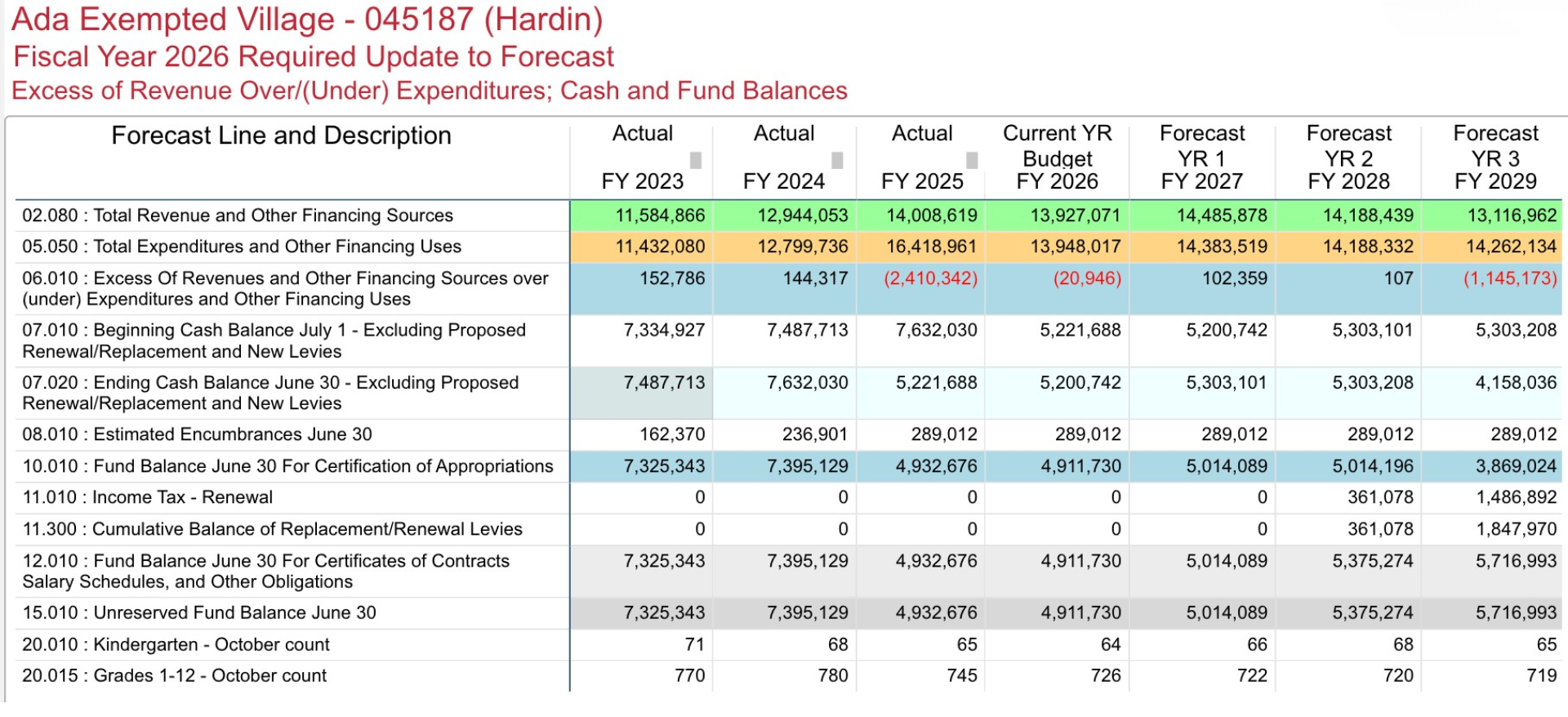
The forecast shows a potential budget shortfall of over $1M for fiscal year 2029.
FUNDING SOURCES
- Income tax is the largest source of local revenue for the Ada Schools (19.34% in 2026).
- Property tax is the second largest source of local revenue (17.38% in 2026). Authoritative data on HB 186’s impact was not available for use in this forecast, causing uncertainty regarding future property taxes
- State sources have provided over half of General Fund Revenues (58.03% in 2026)
FORECAST
- District revenues and expenditures are expected to be roughly equal in Fiscal Years 2027 and 2028
- District expenditures are forecast to exceed revenues in 2029 and 2030
- June 30 Cash Balance is forecast to change from $7.4M in 2023 to $2.6M in 2030
- Average daily membership for K-12 is expected to shrink from 841 in 2023 to 787 in 2030
REPORT CONCLUSION
“The district is expected to see a reduction in property tax revenue due to the recent legislation. The full extent of the impact is unknown and the estimated impacts are based on limited data that has been provided as there is no definitive information from the Ohio Department of Taxation at this time.”
|
FY 2023 |
FY 2024 |
FY 2025 |
FY 2026 |
FY 2027 |
FY 2028 |
FY 2029 |
FY 2030 |
|
|
Total Revenues and other financing |
$11.6M |
$12.9M |
$14.0M |
$13.9M |
$14.5M |
$14.2M |
$13.1M |
$13.2M |
|
Expenditures and other financing uses |
$11.4M |
$12.8M |
$16.4M |
$13.9M |
$14.4M |
$14.2M |
$14.3M |
$14.8M |
|
Cash balance |
$7.5M |
$7.6M |
$5.2M |
$5.2M |
$5.3M |
$5.3M |
$4.2M |
$2.6M |
|
Unreserved fund balance |
$7.3M |
$7.4M |
$4.9M |
$4.9M |
$5.0M |
$5.4M |
$5.7M |
$5.6M |
McVey explained that there are several recent Ohio House Bills that could impact how schools receive local funding.
House Bill 129 - Better known as Property Tax reform. The bill closes loopholes in the 20-mill floor, a mechanism that guarantees schools a minimum property tax amount.
House Bill 186 - A major property tax relief initiative designed to limit school district property tax increases to the rate of inflation.
House Bill 309 - Gives county Budget Commissions more authority. If a school district proposes a levy and the voters pass the levy, the County Budget Commission could reduce/override the amount. The bill aims to reduce property taxes by expanding the authority of county budget commissions.
HB 335 caps revenue growth from inside millage growth due to inflation, measured by the GDP deflator over the prior three years in reappraisal/triennial update years. This is updated by the county budget commission. Ada does not expect an adjustment to our projected tax revenues.
Property tax reform could have a real impact on how the Ada Schools are funded. Reforms could cause funding gaps.